
Business safety protects your employees, shields your company from liability, and strengthens your bottom line by reducing downtime, insurance costs, and regulatory penalties. Building an effective safety program requires three core elements: a culture of accountability that starts at the leadership level, clear protocols tailored to your specific operational risks, and regular training that keeps safety awareness active rather than theoretical.
The business case for safety has never been stronger. Companies with mature safety programs report 52% fewer incidents and save an average of $4 to $6 for every dollar invested in prevention measures. Beyond the numbers, workplace safety drives operational excellence. When employees trust that their wellbeing matters, productivity rises, turnover drops, and innovation flourishes because teams focus on solutions rather than avoiding hazards.
For businesses in energy and technical sectors, safety considerations extend beyond traditional workplace concerns. Equipment failures, environmental compliance, and operational disruptions carry compounding costs that ripple through supply chains and customer relationships. Integrating safety into every business decision creates safer operations while supporting broader sustainability goals.
This guide provides a practical framework for implementing or upgrading your safety program in 2026. You’ll find specific strategies for risk assessment, compliance management, employee engagement, and measuring results. Whether you’re launching your first formal safety initiative or refining an existing program, these insights will help you build a workplace where safety and success reinforce each other.
Why Business Safety Matters More Than Ever in 2026
Workplace safety has evolved from a regulatory checkbox to a strategic business priority that directly influences your company’s viability and growth potential. Three converging forces make safety more critical now than in previous years: heightened regulatory scrutiny following recent high-profile incidents across the energy sector, a competitive talent market where prospective employees research safety records before accepting offers, and insurance carriers implementing stricter underwriting standards that tie premiums directly to documented safety performance.
The financial stakes have never been clearer. When safety programs fall short, businesses face compounding costs that extend far beyond the immediate incident:
- Workplace injuries cost U.S. businesses over $170 billion annually in direct and indirect expenses
- Each recordable safety incident triggers an average of 8-12 days of lost productivity per affected employee
- Companies with poor safety records experience 45% higher employee turnover rates
- Insurance premiums can increase 25-40% following a single serious incident
- Safety violations and accidents damage reputation, reducing competitive positioning in contract bidding
Today’s workforce prioritizes workplace safety as a non-negotiable employment factor, particularly among skilled professionals in technical and renewable energy fields where demand outstrips supply. Employees share safety concerns publicly through review platforms and industry networks, meaning a single incident can undermine your recruitment efforts for months. Companies that demonstrate genuine commitment to safety report easier hiring, stronger retention, and improved morale across their teams.
The business case extends beyond avoiding costs. Organizations with robust safety programs consistently outperform peers in productivity metrics, project completion rates, and client satisfaction scores. Safety-focused companies secure better insurance rates, qualify for contracts requiring specific safety credentials, and build reputations that translate to premium positioning in competitive markets. In sectors like renewable energy installation and environmental services, where technical complexity meets physical risk, safety excellence becomes a competitive differentiator that opens doors to larger projects and strategic partnerships.
Core Elements of an Effective Business Safety Program
Risk Assessment and Hazard Identification
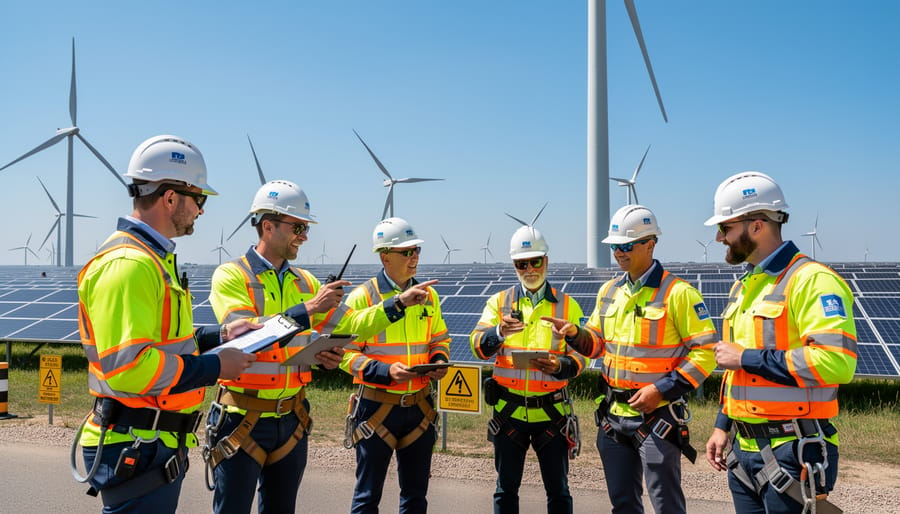
Risk assessment starts with a structured walk-through of every area where your employees work. Look for obvious hazards first, exposed electrical connections, unmarked chemical containers, unstable storage racks, or equipment lacking proper guards. Then dig deeper into less visible risks: repetitive motions that cause injury over time, poor ventilation in confined spaces, or inadequate fall protection on elevated platforms. OSHA’s hazard identification and assessment framework provides a systematic approach that works across industries.
In renewable energy operations, hazards shift with the work environment. Solar installers face electrical shock from DC systems, falls from rooftops, and heat exposure during summer months. Wind technicians contend with extreme heights, confined nacelle spaces, and mechanical pinch points in moving components. Environmental service teams handle corrosive chemicals, navigate slippery surfaces around water treatment systems, and enter tanks or pits where oxygen levels can drop dangerously low.
Document every identified hazard with its location, severity, and likelihood. Rank them using a simple matrix, high-probability, high-consequence risks demand immediate action, while low-level hazards might accept scheduled improvements. This prioritization helps you allocate resources effectively and prevent failures before they escalate into incidents. Involve employees directly; the people doing the work often spot risks management overlooks. Update your assessment quarterly and whenever you introduce new equipment, processes, or work sites.
Employee Training and Safety Culture
Training transforms safety from a poster on the wall into daily practice. Start with comprehensive onboarding that covers both general workplace hazards and role-specific risks, new hires in renewable energy operations need to understand electrical safety, fall protection, and emergency procedures before touching equipment. Schedule refresher training at least annually, and whenever you introduce new processes or equipment.
But training alone won’t protect your people. You need a safety culture where every team member feels empowered to stop work when something looks unsafe. This means leadership must model safe behavior consistently, not just talk about it. When a supervisor cuts corners to meet a deadline, they’ve told the crew that speed matters more than safety, no matter what the handbook says.
Create feedback loops where employees can report hazards without fear of blame. Hold brief safety meetings before shifts to discuss specific risks for that day’s work. Celebrate teams that identify problems before they become incidents. When someone does get hurt, investigate thoroughly to understand the system failure, not to find someone to punish. Your goal is preventing the next injury, not assigning fault for the last one.
Documentation and Compliance
Proper documentation forms the backbone of your safety program, serving as both legal protection and operational memory. When an incident occurs or an inspector arrives, your records tell the story of your safety commitment and due diligence.
Start with maintaining injury and illness logs as required by OSHA or your local jurisdiction. These records track incidents, near-misses, and corrective actions taken. Beyond the legal mandate, this data reveals patterns that help prevent future accidents. A single slip might seem random, but five slips in the same location over six months signals a hazard needing attention.
Equipment inspection records prove you’ve maintained machinery and safety systems properly. Document training completion for every employee, including dates, topics covered, and trainer qualifications. When someone claims they never received fall protection training, your records either vindicate you or expose a gap you need to fill.
Safety Data Sheets for every chemical on-site must be current and accessible. Employees need immediate access during emergencies, and outdated sheets can lead to incorrect response procedures.
Create standard operating procedures for high-risk tasks and require documented acknowledgment that workers understand them. These written protocols establish clear expectations and demonstrate to regulators that you’ve identified hazards and implemented controls.
Digital systems simplify record-keeping and ensure documents survive longer than paper files prone to damage or loss. Whatever your method, consistency matters more than complexity. Records you actually maintain protect you far better than elaborate systems you abandon after three months.
Industry-Specific Safety Considerations
Renewable Energy Installation and Maintenance
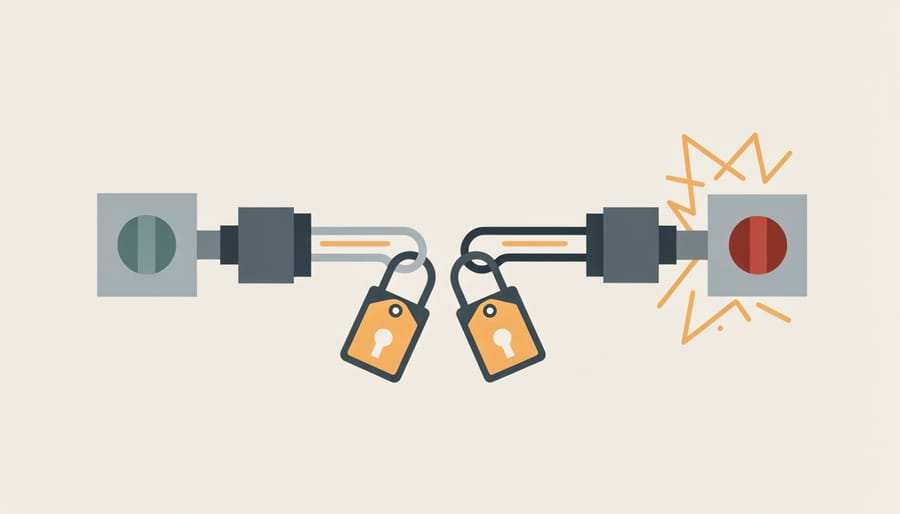
Renewable energy installations present distinct safety challenges that require specialized protocols and constant vigilance. Working at heights on solar arrays and wind turbines demands fall protection systems, harnesses rated for rescue operations, and team members trained in aerial work procedures. Electrical hazards multiply during installation and maintenance because systems often remain partially energized even during service work, lock-out/tag-out procedures become non-negotiable, and crews must verify zero-energy states before touching any components. The electric interconnection phase introduces additional risks as your system ties into the grid, requiring coordination with utility protocols and certified electricians who understand both DC and AC systems.
Every renewable energy team needs these baseline protections:
- Arc-rated clothing and insulated gloves for all electrical work above 50 volts
- Rescue-capable fall arrest systems with documented inspection schedules
- Lockout/tagout kits and energy isolation verification tools
- Weather monitoring systems to halt work during lightning or high wind conditions
- Two-person minimum crews for any height work or energized equipment maintenance
Maintenance operations carry equal weight because familiarity breeds complacency. Your technicians might service the same solar installation monthly, but environmental factors change: panels become slippery with morning dew, wind patterns shift seasonally, and electrical connections degrade over time. Regular refresher training and site-specific safety briefings before each job keep teams sharp and procedures current, protecting both your people and the long-term performance of the energy systems you install.
Environmental and Technical Operations
Chemical handling, confined space entry, and equipment operation present distinct hazards in environmental and technical services that demand specialized protocols. Businesses working with wastewater treatment, remediation projects, or environmental monitoring must account for exposure to hazardous substances, oxygen-deficient atmospheres, and heavy machinery risks.
Start with proper chemical inventory management and safety data sheets accessible at every work site. Train employees on correct PPE selection for specific chemicals, proper storage procedures, and spill response protocols. Never assume workers understand chemical hazards, regular refresher training prevents complacency.
Confined space work requires permit systems before entry, continuous atmospheric monitoring, and dedicated rescue plans. Trenches, tanks, manholes, and underground installations all qualify as confined spaces where toxic gases, engulfment hazards, or oxygen depletion can occur rapidly. Establish clear communication between workers inside and outside these spaces, and never allow solo entry.
Equipment operation safety extends beyond operator training to include pre-use inspections, lockout-tagout procedures during maintenance, and clear exclusion zones around active machinery. Environmental field work adds weather exposure, wildlife encounters, and terrain hazards that office-based risk assessments often overlook. Document site-specific hazards before each project and adjust your safety plan accordingly.
Off-Grid and Remote Site Safety
Operating in remote or off-grid locations introduces safety challenges that standard workplace protocols don’t adequately address. When your nearest hospital is hours away and mobile phone coverage is non-existent, conventional emergency response plans become dangerously inadequate.
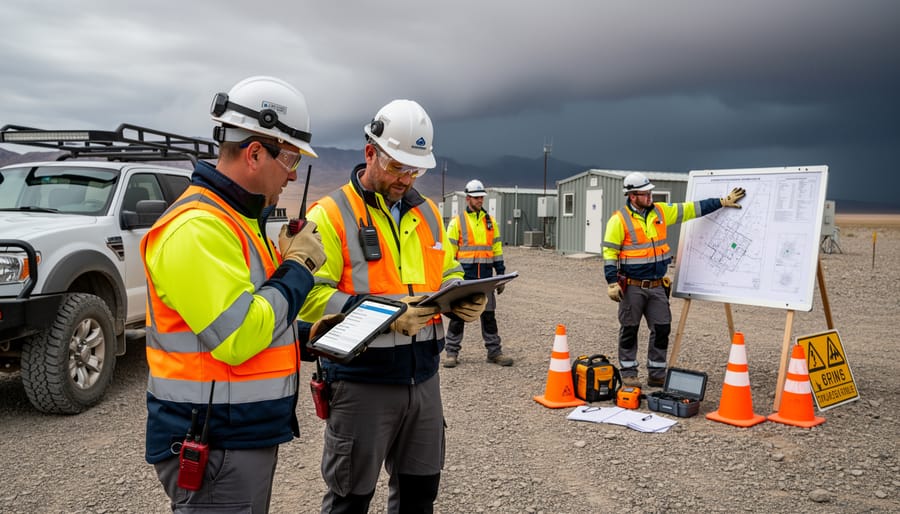
Communication systems are your lifeline. Satellite phones, two-way radios with sufficient range, and personal locator beacons should be standard equipment, not optional extras. Establish mandatory check-in schedules, if a team misses a scheduled contact, your emergency protocol activates immediately.
Emergency response planning must account for delayed assistance. Train multiple team members in advanced first aid and equip remote sites with comprehensive medical kits that go beyond basic supplies. Know your helicopter evacuation options and keep detailed site access information updated for emergency services.
The buddy system isn’t negotiable in remote work. Never allow solo operations where help can’t arrive quickly. For unavoidable solo tasks, implement regular check-ins and dead-man switches, automated alerts triggered when expected contact doesn’t occur.
Weather monitoring becomes critical when storms can cut off access for days. Maintain emergency supplies including shelter, water, food, and backup power sufficient for extended isolation.
Building Your Safety Program: Practical Steps
Creating a robust safety program doesn’t require starting from scratch or hiring expensive consultants. Most business owners can build an effective framework by following a systematic approach that grows with their operations.
Start by conducting an honest baseline assessment of your current state. Walk through your facilities with fresh eyes, talk to employees at all levels about near-misses and concerns, and review any incident reports from the past two years. This initial audit reveals gaps between your current practices and where you need to be, both for compliance and optimal operations.
Once you understand your starting point, follow these practical steps to build your program:
- Document your commitment in writing. Create a safety policy statement that defines management’s responsibilities, employee expectations, and your organization’s safety goals. This becomes the foundation document that guides all subsequent decisions.
- Identify and prioritize your specific hazards. Based on your initial assessment, list every risk your employees face, then rank them by likelihood and potential severity. Focus your early efforts on the highest-priority items.
- Develop standard operating procedures for high-risk tasks. Write clear, step-by-step instructions for activities that could result in serious injury, and involve the workers who actually perform these tasks in creating these documents.
- Establish training schedules and requirements. Determine what training each role needs, how often refreshers are necessary, and who will deliver the instruction. Consider adopting a modular safety training approach that allows you to scale instruction as your business evolves.
- Create an incident reporting and investigation process. Make it simple for employees to report hazards and near-misses without fear, and commit to investigating every incident to identify root causes rather than assigning blame.
- Schedule regular reviews and updates. Set quarterly meetings to review metrics, update procedures based on lessons learned, and address emerging hazards as your operations change.
Implementation works best when rolled out in phases rather than all at once. Tackle your highest-priority risks first, demonstrate early wins to build momentum, then expand systematically. Assign clear ownership for each program element so nothing falls through the cracks, and communicate progress regularly to keep safety visible across your organization.
The ROI of Safety: Beyond Compliance
Meeting regulatory requirements is just the starting point. When you invest in comprehensive safety programs, you’re building business value that shows up across multiple financial metrics.
Insurance companies reward proactive safety management. Businesses with documented safety programs and low incident rates typically see premium reductions of 10-30% compared to industry averages. Every prevented accident saves not just the direct costs of medical care and workers compensation, but the hidden expenses of incident investigation, production downtime, equipment repair, and temporary staffing.
Employee retention improves measurably in safer workplaces. The cost of replacing a trained technician or installer runs between 50-200% of their annual salary when you factor in recruitment, onboarding, and the productivity gap during training. Workers stay longer at companies where they feel their wellbeing matters. That stability means your team accumulates expertise, works more efficiently, and delivers higher quality results.
Productivity gains emerge from fewer disruptions and greater confidence. When your crews know proper protocols and trust their equipment, they work faster without cutting corners. One renewable energy installer reported 15% productivity increases after implementing systematic safety training, simply because workers spent less time second-guessing procedures and navigating uncertainty.
Your safety record opens doors. Many large commercial clients and government contracts require proof of strong safety performance before you can even bid. Energy companies, municipalities, and industrial facilities increasingly demand low experience modification rates and documented safety programs from contractors. Strong safety credentials differentiate you in competitive markets and justify premium pricing.
The businesses thriving in 2026 recognize safety as a profit center, not a cost center.
Business safety isn’t just another operational expense, it’s a strategic investment that protects your most valuable assets while strengthening your company’s foundation for growth. When you prioritize the wellbeing of your team, you’re simultaneously building operational efficiency, financial resilience, and a reputation that attracts both talent and clients.
The businesses thriving in 2026 understand that safety and sustainability aren’t competing priorities. They’re interconnected pillars of responsible operations. A workplace that protects its people naturally aligns with broader environmental and social responsibility goals, creating a coherent business identity that resonates with modern customers and partners.
Starting or improving your safety program doesn’t require perfection from day one. It requires commitment to continuous improvement and recognition that every step forward protects lives, reduces costs, and positions your business as an industry leader. The transition toward safer, more sustainable operations begins with a single decision: to value prevention as much as performance.
Your people notice when you invest in their safety. So do your clients, your insurers, and your community. Make that investment count.