Solar power farms represent one of the most significant infrastructure investments a business can make in the renewable energy transition—typically ranging from hundreds of thousands to millions of dollars depending on scale. The difference between a profitable installation that delivers reliable returns for 25+ years and a struggling project that fails to meet expectations often comes down to decisions made during the design phase, long before the first panel is installed.
Modern solar farm design extends far beyond simply arranging photovoltaic panels in rows. It encompasses comprehensive site analysis including solar irradiance mapping, ground conditions assessment, and grid connection feasibility. It requires balancing energy production optimization with construction costs, navigating municipal regulations and environmental considerations, and developing robust financial models that account for Canadian climate challenges. The design phase determines your project’s capacity factor, operational efficiency, maintenance requirements, and ultimately, your return on investment.
For business decision-makers and developers in the early planning stages, understanding the complete design process prevents costly mistakes and positions your project for long-term success. Poor site selection can reduce energy output by 15-30%. Inadequate electrical infrastructure planning can add hundreds of thousands in unexpected costs. Overlooking snow load considerations or drainage requirements can compromise system performance and longevity.
This comprehensive guide walks through each critical phase of solar farm design—from initial feasibility assessment through operational commissioning—providing practical insights that bridge technical requirements with business realities, specific to the Canadian context where innovation meets the unique demands of our climate and regulatory environment.
The Foundation: What Makes Solar Power Farm Design Different
Scale and Complexity Considerations
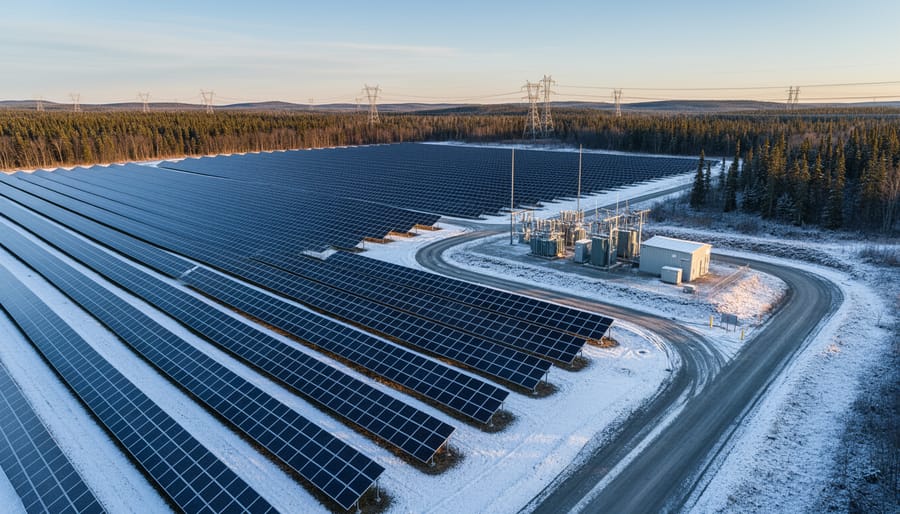
Solar power farms operate on an entirely different scale than commercial solar installations, requiring specialized engineering approaches that address unique challenges. While a rooftop system might involve 50-100 panels, utility-scale solar farms deploy thousands or tens of thousands of panels across multiple acres, creating complexities in electrical design, structural engineering, and project coordination.
Large-scale installations demand heavy-duty mounting systems engineered to withstand extreme weather conditions over decades. Equipment specifications shift from residential-grade inverters to industrial central inverters or string inverters capable of managing megawatts of power. The electrical infrastructure becomes substantially more complex, requiring medium-voltage transformers, switchgear, and interconnection equipment that meets utility-grade standards.
Planning horizons also extend considerably. Where small commercial projects might take months from conception to commissioning, solar farms typically require 18-36 months or longer. This extended timeline accounts for comprehensive site assessments, environmental impact studies, utility interconnection agreements, and phased construction approaches that manage capital deployment efficiently.
These scale considerations directly impact your investment strategy, requiring larger upfront capital but offering superior economies of scale and long-term return potential. Understanding these differences early ensures realistic expectations and proper resource allocation for your renewable energy transition.
Beyond Panels: The Complete System Approach
A successful solar power farm extends far beyond the photovoltaic panels themselves. While panels capture sunlight, they’re just one component within an integrated ecosystem designed to transform, manage, and deliver clean energy reliably. Understanding this complete system approach is essential for making informed investment decisions.
Solar power systems at the commercial scale require inverters to convert the DC electricity generated by panels into AC power suitable for the electrical grid. These sophisticated devices continuously optimize performance while protecting equipment from power surges and grid disturbances. Transformers then step up this voltage to match grid transmission requirements, ensuring efficient energy transfer with minimal losses.
Energy storage solutions, typically large-scale battery systems, provide crucial flexibility by storing excess generation for use during peak demand periods or cloudy conditions. This capability significantly enhances the financial return of your investment while supporting grid stability.
Monitoring systems act as the farm’s nervous system, tracking performance metrics in real-time, identifying underperforming components, and predicting maintenance needs before failures occur. These intelligent platforms enable proactive management that maximizes uptime and revenue generation.
Finally, grid connection infrastructure including switchgear, metering equipment, and control systems ensures seamless integration with the broader electrical network while meeting utility requirements and safety standards. Each component plays a vital role in creating a reliable, profitable renewable energy asset.
Site Selection: Where Your Solar Farm Stands Determines Where Your Business Goes
Solar Resource Assessment
Understanding your site’s solar resource is the foundation of accurate energy production forecasting and financial modeling. A comprehensive solar resource assessment evaluates three critical factors: average sun exposure measured in kilowatt-hours per square meter per day, seasonal variations throughout the year, and local weather patterns that affect panel performance.
Professional assessments typically analyze multiple years of historical weather data, including sunshine hours, cloud cover frequency, and atmospheric conditions. This data reveals your site’s solar irradiance—essentially how much usable sunlight reaches ground level. In Canadian climates, seasonal variation is particularly significant, with summer months potentially generating three to four times more energy than winter periods.
Modern assessment tools combine satellite imagery, ground-based measurements, and sophisticated modeling software to predict generation potential with remarkable accuracy. These evaluations account for factors like morning fog, afternoon cloud patterns, and snow accumulation that can temporarily reduce output.
The assessment results directly inform equipment selection, system sizing, and financial projections. Most importantly, they provide realistic expectations about your solar farm’s performance, helping you make informed decisions about project viability. While initial assessments require investment, they protect against costly miscalculations and ensure your renewable energy transition rests on solid data rather than optimistic assumptions.
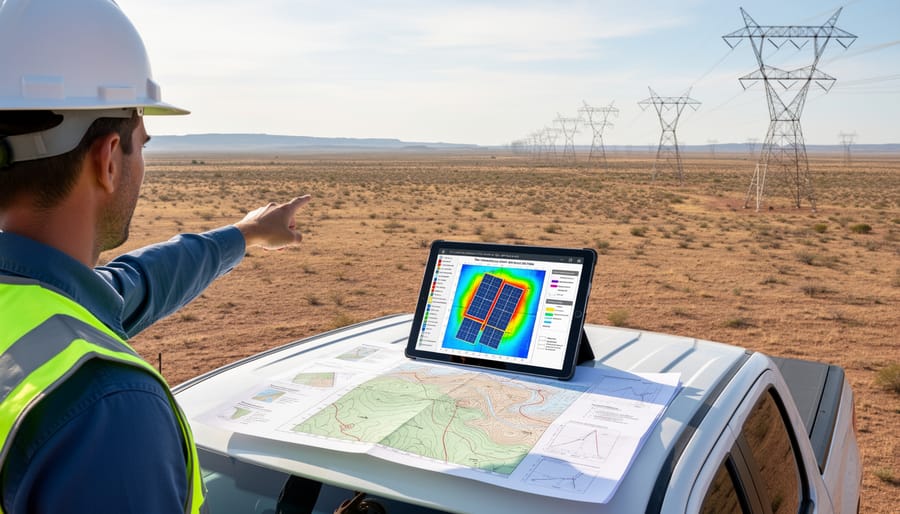
Land and Environmental Factors
The physical characteristics of your chosen site significantly influence both construction expenses and operational efficiency. Terrain plays a crucial role—flat or gently sloping land reduces grading costs and simplifies panel installation, while steep slopes require additional engineering and may limit usable space. When evaluating potential locations, conduct thorough topographical surveys to identify any terrain modifications needed before construction begins.
Soil composition directly affects foundation stability and drainage systems. Clay-heavy soils may require enhanced drainage solutions to prevent water accumulation around equipment, while sandy soils offer better natural drainage but may need reinforced foundations. A comprehensive geotechnical analysis helps identify potential issues early, allowing you to budget appropriately for soil remediation or specialized foundation systems.
Vegetation management requires careful planning. Clearing native plants can trigger environmental regulations and increase erosion risks, so work with environmental consultants to develop sustainable clearing strategies. Some vegetation can actually benefit your operation by preventing soil erosion and reducing dust that might accumulate on panels.
Environmental impact assessments are essential for regulatory compliance and community acceptance. These studies examine effects on local wildlife, water resources, and ecosystems. While they represent an upfront investment, thorough environmental planning prevents costly delays, builds stakeholder trust, and demonstrates your commitment to responsible development that benefits both your business and the surrounding environment.
Grid Connection and Infrastructure Access
Successful solar farm development hinges significantly on access to adequate grid infrastructure. Your project’s proximity to existing transmission lines directly impacts construction costs and overall viability—extending power lines even a few kilometers can add hundreds of thousands of dollars to your budget.
Grid capacity represents another crucial consideration. The local electrical grid must have sufficient capacity to absorb the power your solar farm generates. In regions with limited grid infrastructure, you may face curtailment issues where your facility cannot operate at full capacity, directly affecting revenue projections.
Interconnection agreements with utility providers formalize how your solar farm connects to the grid. These negotiations can take months or even years to complete, involving technical studies, upgrade costs, and queue positions. Understanding interconnection timelines early in your planning process prevents costly delays and ensures realistic project schedules.
Working with experienced renewable energy partners helps navigate these complex infrastructure requirements. They can assess grid constraints during site selection, manage utility negotiations, and identify potential bottlenecks before they impact your investment timeline. Smart planning around grid access transforms infrastructure challenges into strategic advantages for your solar power farm.
Engineering the Layout: Maximizing Output While Managing Costs
Panel Positioning and Array Configuration
How you position solar panels significantly impacts your farm’s energy production and long-term profitability. The configuration you choose must balance maximum energy capture with cost efficiency and land optimization.
Solar farms typically use one of two mounting systems: fixed-tilt or tracking. Fixed-tilt systems mount panels at a static angle, offering simplicity and lower upfront costs. These systems require minimal maintenance and provide reliable performance over decades. For Canadian climates, fixed-tilt arrays typically perform best at angles between 30 and 45 degrees, matching local latitude to optimize year-round solar collection. This positioning captures both summer and winter sun effectively, accounting for Canada’s seasonal variations.
Tracking systems follow the sun’s movement throughout the day, rotating on either a single axis (east to west) or dual axes (east to west and seasonal tilt adjustment). Single-axis trackers can increase energy production by 15 to 25 percent compared to fixed systems, while dual-axis trackers may achieve gains up to 35 percent. However, these benefits come with higher installation costs, increased maintenance requirements, and greater complexity. For Canadian operations, tracking systems face additional challenges from snow accumulation and extreme cold, which can affect mechanical components.
Row spacing represents another critical design consideration. Panels must be positioned far enough apart to prevent shading from adjacent rows, particularly during winter when the sun sits lower on the horizon. Typical spacing ranges from 1.5 to 3 times the panel height, depending on latitude and terrain. While wider spacing reduces shading losses, it also increases land requirements and infrastructure costs. Strategic spacing optimization ensures you maximize energy production per acre while maintaining economic viability for your specific site conditions and business objectives.
Electrical System Design
The electrical system represents the critical pathway that transforms sunlight into usable grid-ready power, making its design essential for maximizing your solar farm’s performance and return on investment.
String sizing involves determining how many solar panels connect in series to create optimal voltage levels for your inverters. This calculation depends on your panels’ specifications, local temperature ranges, and voltage requirements. Properly sized strings ensure your system operates within safe parameters while delivering maximum efficiency throughout varying weather conditions.
Inverter selection directly impacts your facility’s power conversion efficiency and long-term reliability. String inverters offer cost-effectiveness for smaller installations, while central inverters suit large-scale operations. Increasingly, business owners are choosing microinverters or power optimizers for enhanced panel-level monitoring and improved performance in partially shaded conditions.
Combiner boxes consolidate multiple string outputs before routing power to inverters, simplifying cable management and providing essential safety disconnects. Strategic placement reduces conductor lengths and associated power losses.
Electrical routing design minimizes resistance losses through appropriately sized conductors and shortest practical paths. Underground conduit runs protect wiring from environmental exposure while maintaining site aesthetics. Proper grounding and surge protection safeguard your investment against lightning strikes and electrical faults. These coordinated electrical design elements typically reduce system losses to below three percent, ensuring your solar farm delivers maximum financial performance over its operational lifetime.
Energy Storage Integration
Integrating battery storage systems into your solar power farm design transforms a renewable energy generator into a versatile, revenue-optimizing asset. The decision to include storage depends on your business objectives and local market conditions. If your utility offers time-of-use rates with significant peak-hour pricing, batteries capture daytime solar generation and discharge during expensive evening periods, maximizing revenue. This strategy becomes particularly valuable in markets with demand charges or capacity payments. Storage also enhances grid stability by smoothing intermittent solar output and providing backup capacity during outages, which can justify premium contracts with utilities or large commercial customers. The technology has matured significantly, with lithium-ion systems now offering 10-15 year warranties and declining costs. For business owners, the key consideration is whether storage unlocks additional revenue streams or operational benefits that justify the upfront investment. Consider storage essential if you’re targeting energy independence, participating in grid services programs, or operating in regions with unreliable power infrastructure.
Building for the Canadian Climate: Durability Meets Performance
Cold Weather Performance Optimization
Cold temperatures actually improve solar panel efficiency—a significant advantage for Canadian installations. Unlike common assumptions, solar panels in Canada often outperform those in hotter climates because extreme heat reduces electrical output. Silicon-based panels operate more efficiently in cold conditions, sometimes generating up to 25% more power on frigid winter days compared to hot summer afternoons.
However, optimal winter performance requires thoughtful design strategies. Snow accumulation poses the primary challenge, as it blocks sunlight and reduces generation capacity. Effective solutions include installing panels at steeper angles (45-50 degrees) to encourage natural snow shedding, incorporating heating elements along panel edges for critical installations, and ensuring adequate spacing between rows for snow storage and maintenance access.
Modern monitoring systems track temperature coefficients—the rate at which panel efficiency changes with temperature—allowing operators to predict performance variations throughout the year. This data helps establish realistic production expectations and identifies when snow clearing becomes economically justified.
By accounting for cold weather dynamics during the design phase, solar farms can maintain consistent year-round performance while capitalizing on the efficiency gains that winter conditions naturally provide.
Snow and Ice Management
Winter conditions present unique challenges for solar power farms, but smart design strategies ensure consistent performance throughout the year. Understanding how snow and ice affect your solar infrastructure is essential for maximizing return on investment in northern climates.
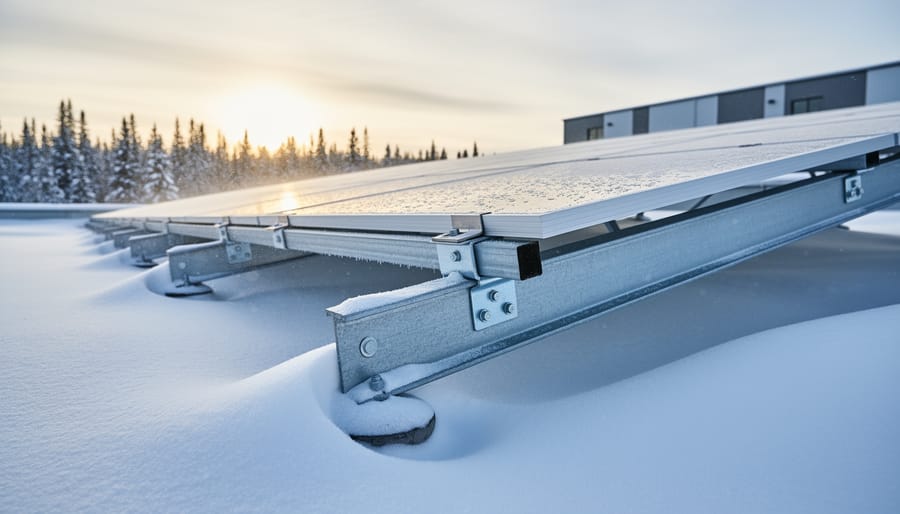
Structural engineering must account for significant snow loads, particularly in regions experiencing heavy winter precipitation. Your solar mounting systems need to withstand the cumulative weight of accumulated snow while maintaining panel stability. Engineers calculate these loads based on historical weather data specific to your location, ensuring your infrastructure meets or exceeds local building codes.
Panel tilt angle serves a dual purpose in solar farm design. While the primary consideration is optimizing sun exposure, strategic tilt angles between 30 and 45 degrees facilitate natural snow shedding. As temperatures fluctuate, snow slides off tilted panels more readily than horizontal surfaces, reducing the need for manual intervention. This passive approach to snow management minimizes maintenance costs and keeps panels generating power.
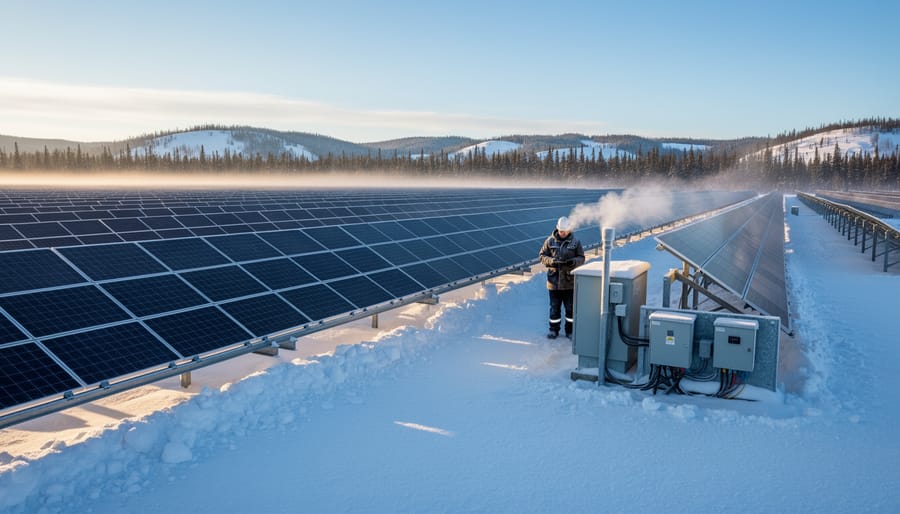
Winter maintenance protocols should include regular monitoring schedules and clear snow removal procedures when necessary. While most snow naturally clears from properly tilted panels, extended overcast periods with persistent snow cover may require gentle clearing techniques using specialized tools that won’t damage panel surfaces. Planning for winter access roads and equipment storage ensures your maintenance team can respond efficiently when conditions demand intervention.
The Economic Blueprint: Designing for Return on Investment
Balancing Upfront Investment with Long-Term Returns
When designing your solar power farm, the equipment you select today will define your operational reality for the next quarter-century or beyond. While premium solar panels and inverters command higher initial costs, this upfront investment often translates into superior long-term returns through enhanced efficiency, durability, and reduced maintenance requirements.
Quality equipment typically delivers 15-20% more energy production over its lifetime compared to budget alternatives. This difference compounds significantly across 25-30 years of operation. For business owners, the true cost of ownership extends far beyond the purchase price—it encompasses maintenance expenses, replacement costs, downtime, and energy output degradation rates.
Warranty structures provide crucial insight into equipment quality. Tier-1 manufacturers typically offer 25-year performance warranties guaranteeing at least 80-85% efficiency at year 25, plus comprehensive 10-15 year product warranties. These commitments reflect manufacturer confidence and protect your investment against premature failure.
Consider this practical example: A budget panel costing 30% less but degrading 0.8% annually versus a premium panel degrading at 0.4% annually creates a substantial performance gap by year 20. The premium option generates more revenue throughout its operational life, often recovering the initial cost difference within 7-10 years while delivering superior returns thereafter.
Smart procurement balances immediate budget constraints with lifecycle economics, ensuring your solar farm remains a profitable, sustainable asset well into the future.
Scalability and Future Expansion
A well-designed solar power farm should accommodate future growth without requiring complete system redesigns. Smart planning today prevents costly retrofits tomorrow and maximizes your long-term return on investment.
Modular design represents the foundation of scalable solar infrastructure. This approach divides your solar array into independent sections, each with its own inverters and monitoring systems. You can activate initial modules to meet current energy demands while leaving space and infrastructure prepared for additional arrays as your business expands. This strategy reduces upfront capital requirements while maintaining flexibility for future growth.
When planning your installation site, designate areas for expansion beyond immediate needs. Even if budget constraints limit initial deployment, securing adequate land and ensuring electrical infrastructure can handle increased capacity prevents future complications. Your inverter capacity, electrical panels, and grid connection should support at least 25-30% more capacity than your initial installation.
Consider technological advancement in your planning. Solar panel efficiency continues improving, meaning future expansions may generate more power using less space than your original installation. Design your mounting systems and electrical conduits with standardization in mind, ensuring compatibility with evolving technologies.
Document your system architecture thoroughly, including electrical diagrams, equipment specifications, and expansion capabilities. This documentation streamlines future additions and helps contractors understand your infrastructure quickly, reducing expansion costs and implementation timelines.
Regulatory Navigation and Community Integration
Permits, Approvals, and Compliance
Navigating the regulatory landscape is essential before breaking ground on your solar farm project. In Canada, solar power installations must comply with requirements at three government levels, each influencing your design approach from the outset.
At the federal level, projects exceeding certain capacity thresholds may require environmental impact assessments under the Impact Assessment Act, particularly if they affect federal lands or interprovincial infrastructure. Provincial regulations vary significantly across Canada. In Saskatchewan, for example, you’ll need approval from the Saskatchewan Environmental Assessment Board for larger installations, plus interconnection agreements with SaskPower that dictate technical specifications.
Municipal zoning bylaws often present the most immediate design constraints. These regulations govern land use classifications, setback distances from property lines, maximum height restrictions for panels and equipment, and visual impact considerations. Some municipalities require development permits and public consultation processes that can influence project timelines.
Early engagement with regulatory authorities streamlines the approval process and prevents costly design revisions. Working with experienced partners who understand this regulatory framework ensures your project design incorporates compliance requirements from day one, avoiding delays and budget overruns. Consider permitting timelines as integral to your project planning, as approval processes typically require three to twelve months depending on project scale and location.
Stakeholder Engagement
Successful solar power farm projects depend on more than technical excellence—they require meaningful engagement with the people and communities affected by development. Early and transparent communication with local communities, Indigenous groups, landowners, and municipal authorities builds trust and reduces the risk of project delays or opposition.
Start stakeholder engagement during the initial planning phase, not after decisions have been made. Host information sessions to explain project benefits, including job creation, tax revenue contributions, and environmental advantages. Address concerns openly, whether they relate to visual impact, land use, or property values. This proactive approach demonstrates respect for community input and often leads to valuable insights that improve project design.
In Canada, consultation with Indigenous communities is both a legal requirement and an ethical imperative for projects on or near traditional territories. These discussions should focus on partnership opportunities, environmental stewardship, and economic benefits such as employment and revenue-sharing agreements.
Consider forming community advisory committees that provide ongoing feedback throughout development and operation phases. Some developers offer community investment programs or local ownership opportunities, creating lasting relationships that extend beyond construction. When stakeholders feel heard and included, they become project advocates rather than obstacles, significantly improving your path to regulatory approval and long-term operational success.
Operations and Maintenance by Design
Smart design choices made during the planning phase can dramatically reduce operational headaches and maintenance expenses over your solar farm’s 25-30 year lifespan. When you integrate operations and maintenance considerations into your initial design, you’re essentially building efficiency and cost savings into the DNA of your system.
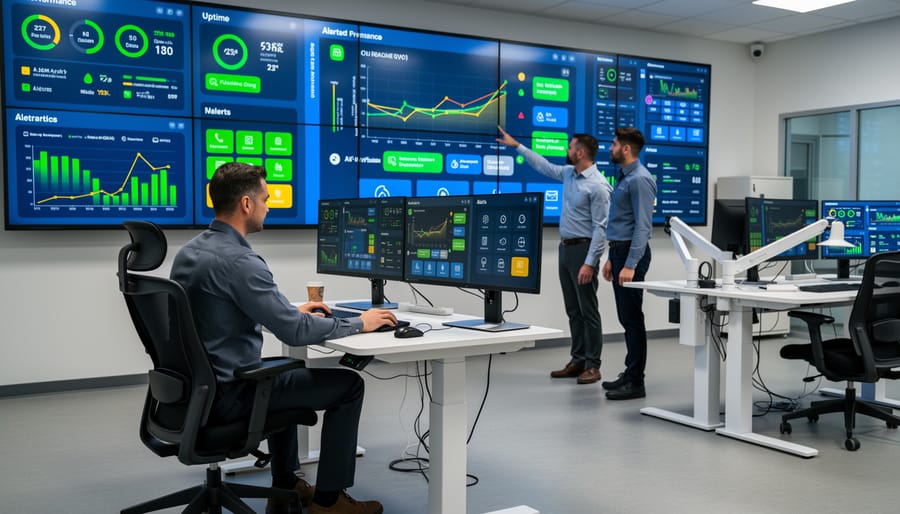
Modern solar farms incorporate sophisticated monitoring systems that track performance at the individual panel level. These digital platforms provide real-time data on energy production, allowing operators to identify underperforming components before minor issues become costly problems. By including comprehensive monitoring infrastructure during the design phase, you gain immediate visibility into system health and can respond proactively rather than reactively to potential failures.
Strategic access planning is another critical design element that pays ongoing dividends. Well-designed service roads and equipment spacing allow maintenance teams to reach any component quickly, reducing labor costs and minimizing system downtime. This becomes particularly valuable during winter months when snow clearing and emergency repairs require efficient site navigation.
Predictive maintenance capabilities represent the cutting edge of solar farm management. By analyzing performance patterns and environmental data, these systems can forecast component failures weeks or months in advance. This foresight enables scheduled maintenance during optimal weather windows and helps you maintain spare parts inventory more efficiently.
Establishing clear maintenance protocols during the design phase ensures consistency and thoroughness throughout the system’s operational life. Your design should account for cleaning schedules, vegetation management, and seasonal inspections, with infrastructure that makes these routine tasks straightforward and cost-effective.
The investment in operations-focused design typically pays for itself within the first few years through reduced emergency repairs, extended equipment life, and maximized energy production. This approach transforms maintenance from an unpredictable expense into a manageable, optimized operational component.
Designing a successful solar power farm isn’t simply about installing panels and connecting them to the grid. It requires a careful balance of technical performance, economic viability, environmental stewardship, and genuine community partnership. Every project presents unique challenges and opportunities, from site characteristics and grid connection capabilities to local regulations and weather patterns. The businesses that thrive in renewable energy understand that cutting corners in the design phase often leads to costly complications during construction and operation.
At Saskatoon Wind & Solar Solutions, we’ve built our reputation on creating customized, scalable designs that address the specific needs of each client and location. We recognize that your decision to invest in solar energy represents a significant commitment to both your business’s financial future and environmental responsibility. That’s why our approach integrates careful site analysis, rigorous technical planning, transparent financial modeling, and proactive stakeholder engagement from day one.
The solar industry continues to evolve rapidly, with advances in panel efficiency, energy storage technology, and grid integration capabilities opening new possibilities each year. This dynamic landscape makes it increasingly important to work with experienced partners who stay current with innovations while maintaining focus on proven, reliable solutions. Success in solar energy requires more than following trends; it demands strategic thinking, technical expertise, and a long-term perspective.
Whether you’re exploring your first solar investment or expanding an existing renewable energy portfolio, the foundation you establish through thoughtful design will determine your project’s performance for decades to come. We’re here to help you navigate that journey with confidence.