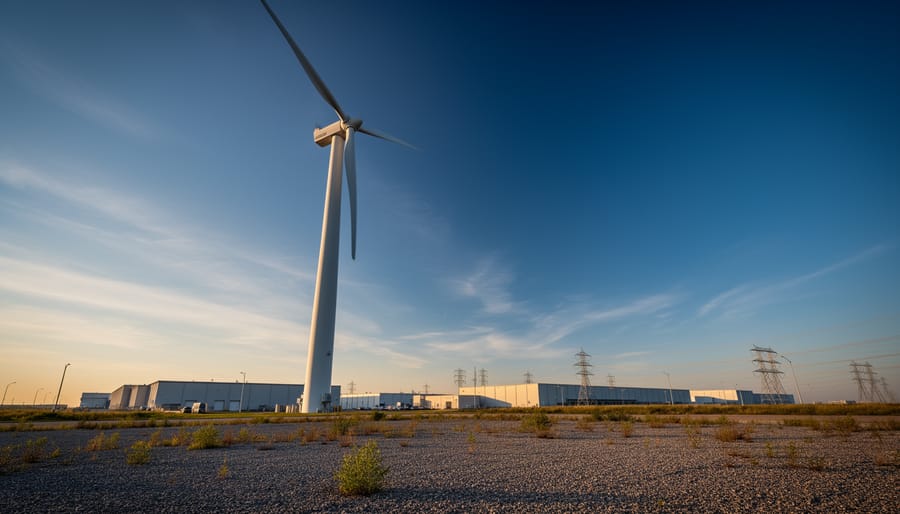
A single commercial wind turbine can generate enough electricity to power 300 to 1,500 homes annually, making it a viable renewable energy investment for Canadian businesses with adequate land, budget, and wind resources. The decision to install one turbine rather than joining a larger wind farm or purchasing renewable energy credits depends on three critical factors: whether your site averages wind speeds above 6 meters per second, whether you can navigate provincial permitting requirements that vary significantly across Canada, and whether your operation can absorb or monetize the 1.5 to 3 megawatts of capacity a commercial turbine typically produces.
For business decision-makers exploring this option in 2026, the calculation has become more favorable. Equipment costs have stabilized, provincial renewable energy incentive programs offer stronger support than five years ago, and corporate sustainability commitments now carry measurable market value. A single turbine installation represents a capital investment ranging from $2.5 million to $4 million, with payback periods typically spanning 10 to 15 years depending on your electricity rates and available incentives.
The practical reality is straightforward: standalone turbines work best for energy-intensive operations like manufacturing facilities, agricultural operations, or industrial parks where on-site consumption matches or exceeds generation. Businesses considering this path need to understand not just the engineering requirements but also power purchase agreements, grid interconnection processes, and the unique zoning challenges that affect single-turbine projects differently than utility-scale wind farms. Canadian case studies from sectors ranging from food processing to mining demonstrate both the opportunities and the site-specific hurdles that determine whether one turbine makes business sense for your operation.
Understanding Single Wind Turbine Systems for Commercial Use

A single wind turbine system for commercial use is a standalone installation designed to meet the energy needs of an individual business, farm, or facility. Unlike massive wind farms that spread hundreds of turbines across vast landscapes to feed power into the provincial grid, these individual installations focus on on-site generation that directly offsets a business’s electricity consumption.
Modern commercial-scale turbines typically range from 100 kilowatts to 3 megawatts in capacity. Smaller installations around 100-500 kW suit operations like manufacturing facilities, agricultural businesses, or commercial buildings with moderate energy demands. Mid-sized turbines in the 500 kW to 1 MW range work well for larger industrial operations, while systems approaching 2-3 MW can power substantial facilities or even support small communities alongside business operations.
The technology behind today’s commercial turbines has evolved significantly. Most feature three-blade horizontal-axis designs with tubular steel towers reaching 80 to 120 metres in height. The increased turbine sizes and capacity over recent years means businesses can generate more power from a single installation than was possible even a decade ago. Advanced blade designs, sophisticated control systems, and improved generator technology allow these turbines to capture energy efficiently across varying wind conditions.
Businesses increasingly choose this approach for several compelling reasons. Direct energy generation provides protection against rising electricity costs and rate volatility. A single turbine offers energy independence without requiring the land commitment, environmental footprint, or complex management associated with large-scale wind farms. The installation becomes an owned asset that generates measurable returns while demonstrating corporate environmental responsibility.
The operational model differs fundamentally from utility-scale wind farms. Rather than selling all generated power to the grid, businesses primarily use turbine output to reduce purchased electricity. Excess generation can typically be sold back to utilities through net metering arrangements or power purchase agreements, creating potential revenue streams. This behind-the-meter generation model means businesses see immediate value through reduced energy bills rather than waiting for wholesale power sales revenue.
Prominent Canadian Wind Energy Projects: Lessons for Your Business
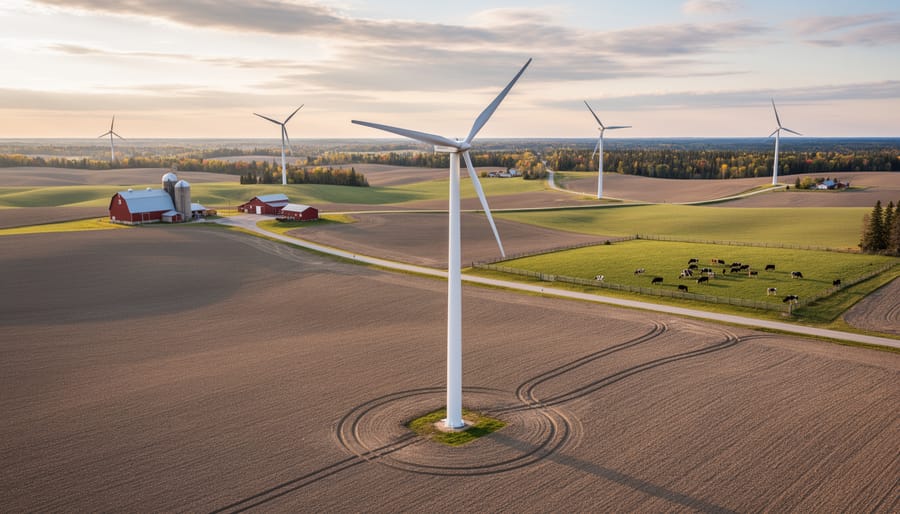
Canada’s wind energy landscape offers compelling blueprints for businesses considering their own renewable investments. While massive installations differ in scale from single turbines, the principles behind their success translate directly to commercial applications.
The country’s wind capacity has grown from small experimental projects to installations generating hundreds of megawatts. This expansion has refined technologies, streamlined regulatory approaches, and demonstrated the economic viability that smaller adopters now benefit from. Large-scale projects have essentially de-risked the technology, proving turbine reliability across Canadian climate conditions from Atlantic coastal winds to prairie gusts.
| Project & Location | Capacity | Key Innovation | Lesson for Business |
|---|---|---|---|
| Niagara Region Wind Farm (Ontario) | 230 MW | Integration with agricultural land use | Wind systems can coexist with existing operations without disrupting core business |
| Bow City Wind Energy (Alberta) | 96 MW | Cold-climate turbine optimization | Modern turbines perform reliably in harsh winter conditions with proper specifications |
| Jardin Wind Farm (Quebec) | 101 MW | Remote site development | Even challenging locations become viable with thorough site assessment and planning |
| Kent Hills Wind Farm (New Brunswick) | 150 MW | Phased expansion approach | Starting smaller and scaling based on performance reduces initial risk |
These major installations validate several critical insights. First, regional wind resources vary significantly, but nearly every province hosts commercially viable projects. Ontario’s lakeside positions and Alberta’s wind corridors demonstrate how geography influences turbine selection and performance expectations. Your business location likely falls within a wind regime that has proven successful at scale.
Second, large projects have established grid interconnection standards and utility relationships that simplify the process for newer adopters. Power purchase agreements, net metering policies, and technical requirements emerged from these pioneering installations. The regulatory pathways they created reduce uncertainty for businesses entering the market today.
Third, technological advances driven by large-scale deployment have made smaller turbines more efficient and cost-effective. The manufacturing economies of scale, improved blade aerodynamics, and enhanced control systems developed for major wind farms now appear in commercial-scale models. You inherit decades of refinement without bearing the development costs.
Perhaps most importantly, these projects demonstrate wind energy’s compatibility with diverse economic activities. Farms, industrial facilities, and mixed-use developments have successfully integrated turbines into their operations. The pattern they establish shows renewable generation as a complement to business activity rather than a competing land use or operational distraction.
Is One Wind Turbine Right for Your Business?
Determining whether a single wind turbine aligns with your operational needs requires a systematic evaluation of several interconnected factors. Not every business location or energy profile makes a compelling case for this investment, but when the conditions align, the benefits can be substantial.
Wind Resource Assessment
Your site’s wind characteristics form the foundation of any turbine feasibility analysis. Commercial-scale turbines typically require average wind speeds of at least 5.5 to 6 meters per second at hub height to generate economically viable returns. Canadian businesses in the Prairie provinces, along Atlantic coastlines, or in southern Ontario’s wind corridors generally have stronger wind resources than those in sheltered valleys or heavily forested regions. Professional wind assessments using meteorological towers or remote sensing technology provide the data needed to project annual energy production accurately.
Land and Space Requirements
Single commercial turbines demand more space than many businesses initially anticipate. Beyond the turbine’s physical footprint, you need adequate setback distances from property lines, buildings, and roads. Most jurisdictions require minimum distances of 300 to 500 meters from occupied structures, though specific regulations vary by municipality. Your site should also accommodate crane access for installation and maintenance, along with clear areas for blade rotation without obstruction.
Energy Consumption Patterns
Businesses with substantial daytime electricity demand and predictable consumption patterns make ideal candidates. Manufacturing facilities, cold storage operations, food processing plants, and agricultural businesses with irrigation or grain drying needs often see the strongest returns. If your annual electricity costs exceed $50,000, a single turbine warrants serious consideration as part of comprehensive business energy solutions.
Regulatory Environment
Local zoning bylaws significantly impact project viability. Some municipalities have streamlined approval processes for commercial renewable energy installations, while others impose restrictions that make projects impractical. Early consultation with municipal planning departments prevents costly surprises during the permitting phase and helps identify any community considerations that might affect project acceptance.
The Economics of Single Turbine Investment
Initial Investment and Installation Costs
Purchasing a commercial-scale wind turbine for your business represents a significant capital investment, typically ranging from $1.5 million to $4 million for units generating 500 kW to 2 MW. The turbine itself accounts for roughly 60-70% of total project costs, with pricing heavily influenced by capacity, manufacturer, and current market conditions.
Foundation and tower installation add another $300,000 to $800,000 to your budget. This covers site preparation, concrete work for the turbine base, tower assembly, and crane rental for installation. Rocky or unstable soil conditions can push foundation costs toward the higher end, while favorable ground conditions may reduce expenses.
Electrical infrastructure represents 15-20% of total investment. You’ll need transformers to step voltage up for grid connection, underground or overhead cabling to your distribution point, and integration equipment that synchronizes turbine output with your existing electrical system. These components typically cost $200,000 to $600,000 depending on distance to your connection point and grid capacity.
Grid connection fees vary significantly by province and utility provider. Some businesses pay $50,000 for straightforward connections, while others face $300,000 or more for grid upgrades required to handle your turbine’s output. Your utility will conduct an interconnection study to determine exact requirements.
Budget an additional 10-15% contingency for unexpected site conditions, permit delays, or equipment modifications. Most Canadian businesses investing in single commercial turbines should anticipate all-in costs between $2.5 million and $5.5 million.
Long-Term Returns and Energy Savings
A commercial wind turbine typically generates between 1,500 and 2,500 MWh annually in regions with moderate to good wind resources like southern Saskatchewan and southern Alberta. For a business consuming 1,000 MWh yearly, this production can offset 100% of electricity purchases while creating surplus energy. At current commercial rates averaging $0.10 to $0.14 per kWh across Canadian provinces, annual savings range from $100,000 to $200,000 for a mid-sized operation.
The real financial advantage emerges over time. Most businesses see payback periods between 8 and 12 years, factoring in both direct energy savings and available incentives. After that point, the turbine continues generating value for its remaining 15 to 25-year operational life. A turbine producing $150,000 in annual savings can deliver $2.25 million in total value over 15 years post-payback.
Net metering programs in provinces like Ontario, Nova Scotia, and Prince Edward Island allow businesses to bank excess generation credits, effectively using the grid as free storage. In Alberta’s deregulated market, surplus electricity can be sold back at real-time wholesale rates, creating an additional revenue stream that ranges from $10,000 to $40,000 annually depending on market conditions and production volumes.
Production consistency matters more than peak output. Unlike wind and solar costs which continue falling, your turbine’s value compounds through stable energy production against rising grid rates. Canadian electricity prices have increased 2% to 3% annually over the past decade. Locking in production costs now protects against future rate escalation while improving budget predictability for energy-intensive operations.
Integration with Existing Energy Systems
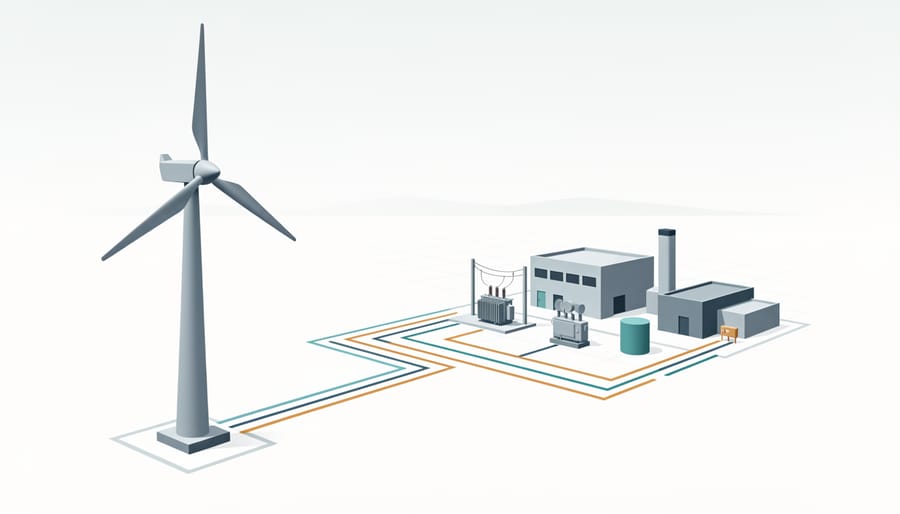
A single commercial wind turbine rarely operates in isolation. Most businesses integrate their turbine with existing electrical infrastructure to create a resilient, optimized energy system that maximizes value and reliability.
Grid-tied systems represent the most common configuration for commercial wind installations. Your turbine generates power during productive wind periods, directly offsetting energy you’d otherwise purchase from the utility. When production exceeds consumption, excess electricity flows back to the grid, potentially generating revenue through net metering agreements or feed-in tariff programs where available. This arrangement requires proper electric interconnection which involves technical assessments, utility coordination, and equipment installations to ensure safe, compliant grid integration.
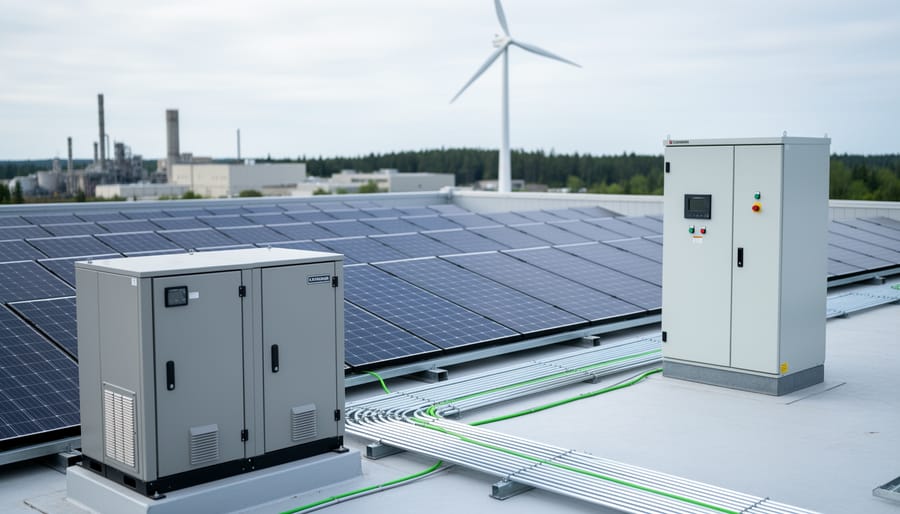
Hybrid systems combining wind with solar photovoltaic arrays offer complementary generation patterns. Wind typically produces more power during winter months and nighttime hours, while solar excels in summer daylight periods. This natural pairing smooths your overall renewable energy production throughout the year, reducing grid dependency more effectively than either technology alone. Many Canadian businesses find this combination particularly valuable given our seasonal variations in both wind resources and solar irradiance.
Battery storage systems add another dimension of control and resilience. Energy storage allows you to capture excess wind generation during high-production periods and deploy it during peak demand times when utility rates are highest. This time-shifting capability transforms your turbine from a variable generator into a dispatchable asset that responds to your operational needs. Storage also provides backup power during grid outages, keeping critical operations running when conventional power fails.
Smart load management systems optimize how your facility consumes renewable energy. Advanced controllers can automatically shift non-critical loads to high-production periods, run industrial processes when wind generation peaks, or pre-cool refrigerated spaces before wind speeds drop. This intelligent demand response maximizes the economic value of every kilowatt-hour your turbine produces.
Understanding renewable interconnection requirements early in your planning process prevents costly delays and ensures your system design meets technical standards from the outset. Working with experienced renewable energy partners streamlines integration complexities, helping you build a coordinated energy system that delivers reliable performance and measurable returns for decades.
Navigating Permits, Regulations, and Community Considerations
Installing a commercial wind turbine requires navigating federal, provincial, and municipal regulations that vary significantly across Canada. The approval process typically takes six to eighteen months, depending on your location and project size, so early engagement with regulatory authorities helps prevent costly delays.
Your approval journey involves several key steps:
- Conduct preliminary site assessment to verify zoning compliance and identify potential restrictions before investing in detailed studies
- Engage with municipal planning departments to understand local bylaws, setback requirements, and permit application procedures specific to your jurisdiction
- Complete environmental screening to assess impacts on wildlife, particularly migratory birds and bat populations, as required by federal regulations
- Submit development permit applications with site plans, technical specifications, and noise impact assessments demonstrating compliance with provincial standards
- Obtain electrical connection approval from your utility provider, including technical review of grid interconnection requirements
- Secure building permits and arrange final inspections before commissioning your turbine
Setback distances represent one of the most critical regulatory considerations. Ontario wind turbine setbacks require minimum distances from residences, roads, and property lines that vary with turbine height, and similar frameworks exist in other provinces. A typical commercial turbine needs at least 300 to 550 metres from the nearest residence, though requirements differ by jurisdiction.
Noise regulations limit sound levels at property boundaries, usually to 40 decibels during nighttime hours. Your turbine supplier should provide sound power data to help you model compliance, and many municipalities require pre-installation noise studies.
Community engagement often determines project success beyond technical approvals. Becoming trusted community partners means proactively addressing neighbour concerns through information sessions, visual simulations showing the installed turbine, and open dialogue about noise, shadow flicker, and property values. Businesses that invest in community relationships before filing permits typically face fewer objections and smoother approval processes.
Maintenance, Performance, and Long-Term Considerations
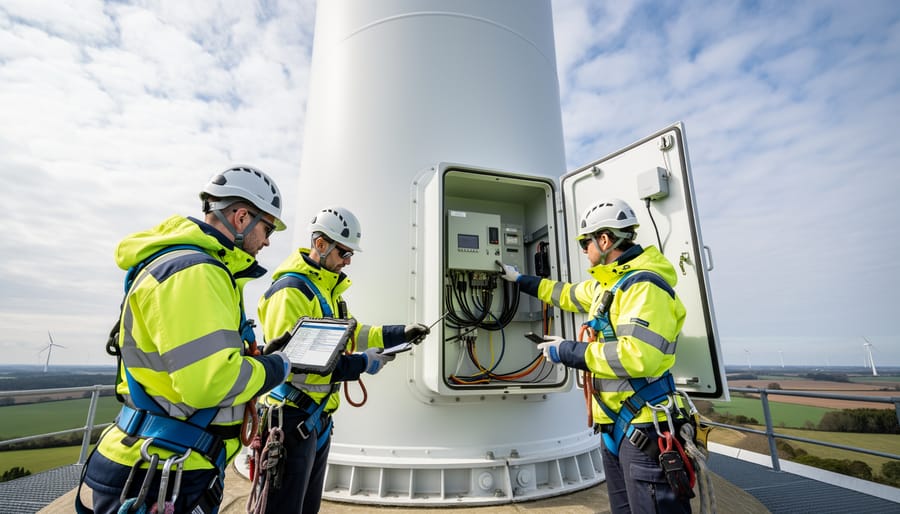
A commercial wind turbine represents a 20 to 25-year commitment, and understanding the operational realities helps you budget accurately and avoid surprises. Modern turbines are engineered for durability, but they require systematic attention to deliver consistent performance throughout their lifespan.
Plan for scheduled maintenance visits every six months during the first few years, scaling to quarterly inspections as the turbine ages. These service calls typically cost $3,000 to $8,000 annually for a single commercial turbine and cover blade inspections, gearbox lubrication checks, electrical system testing, and bolt torquing. Major component overhauls, particularly gearbox rebuilds or generator replacements, may occur around the 10 to 15-year mark, with costs ranging from $50,000 to $150,000 depending on turbine size.
Performance monitoring systems provide real-time data on energy production, wind speeds, operational status, and fault alerts. These dashboards let you compare actual output against projected generation, identify underperformance early, and track your return on investment with precision. Most systems connect through cellular or internet links, allowing remote diagnostics that reduce service call costs.
Canadian winters demand specific attention. Ice accumulation on blades reduces efficiency and creates safety hazards, so many operators install heating systems or blade coatings in high-icing regions. Cold temperatures can thicken lubricants, requiring winter-grade fluids. Lightning protection systems need regular verification, particularly in storm-prone areas.
Turbine availability, the percentage of time your system generates power when wind is sufficient, should exceed 95% with proper maintenance. Drops below this threshold signal developing problems that warrant immediate investigation.
As your turbine approaches 20 years of service, begin planning for decommissioning or repowering. Foundation removal, blade disposal, and site restoration typically cost $30,000 to $80,000, though scrap metal from the tower and nacelle can offset some expenses. Alternatively, repowering with modern turbine technology can extend site productivity for another two decades while dramatically improving output efficiency.
The transition to renewable energy through a single wind turbine represents more than an infrastructure investment, it’s a strategic decision that positions your business at the forefront of Canada’s clean energy future. While major projects like Ontario’s Niagara Region Wind Farm and Alberta’s wind corridors demonstrate the massive potential of wind power at scale, individual commercial turbines bring that same proven technology within reach of businesses ready to take control of their energy costs and environmental impact.
The success stories across Canadian provinces share common threads: proper site assessment, realistic financial modeling, thorough understanding of regulatory requirements, and commitment to long-term performance. Your single turbine project deserves the same careful planning that guides multi-megawatt installations. The difference lies in scale, not in the fundamental principles of wind energy success.
Every business faces unique energy challenges, site conditions, and financial parameters. What works for a manufacturing facility in southern Alberta won’t necessarily fit a commercial operation in Saskatchewan or Ontario. This is where specialized expertise makes the difference between a turbine that delivers expected returns and one that underperforms.
At Saskatoon Wind & Solar Solutions, we’ve guided businesses through every stage of renewable energy adoption, from initial feasibility studies to long-term performance optimization. Our approach combines technical knowledge of wind systems with deep understanding of Canadian business realities and regulatory landscapes. We customize solutions based on your specific energy profile, budget, and goals rather than pushing one-size-fits-all packages.
The wind resource is there. The technology is proven. The question is whether your business is ready to harness it effectively. We’re here to help you find that answer.