Portable wind turbines for camping can supplement your power needs in consistently windy locations, typically generating 50 to 400 watts depending on wind speed and turbine size, but they work best as part of a hybrid setup with solar panels rather than as your primary power source. The reality is straightforward: if your campsite receives sustained winds of at least 10 to 12 mph, a compact turbine can charge batteries overnight when solar panels sit idle, extending your off-grid capability. However, many campers overestimate wind availability at their favorite spots and end up carrying equipment that underperforms.
The decision hinges on three practical factors: the typical wind conditions where you camp, your actual power requirements, and whether you’re willing to manage a system that demands more setup and maintenance than solar alternatives. Vertical-axis models offer easier portability and work in variable wind directions, while horizontal-axis turbines deliver higher output in steady breezes but require careful positioning. Weight matters too. Most camping-appropriate turbines range from 8 to 25 pounds, and you’ll need to secure them properly to prevent damage during gusts.
Business-minded outdoor enthusiasts increasingly view portable wind as part of a broader shift toward renewable energy sources that reduce reliance on noisy generators. This guide walks you through the specific buying criteria that matter for recreational use, compares turbine types with camping contexts in mind, highlights realistic features to expect in 2026, and warns you away from common purchasing mistakes that leave campers frustrated with their investment.
What Makes a Camping Wind Turbine Worth Considering
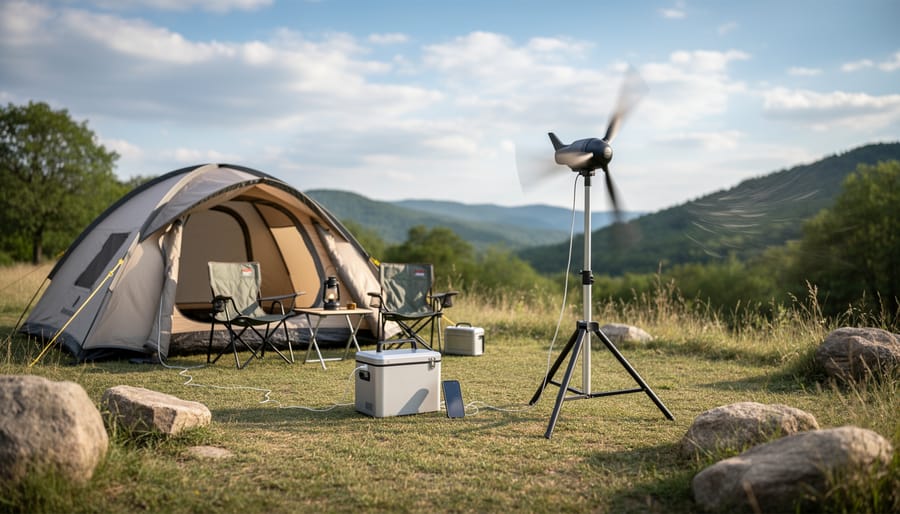
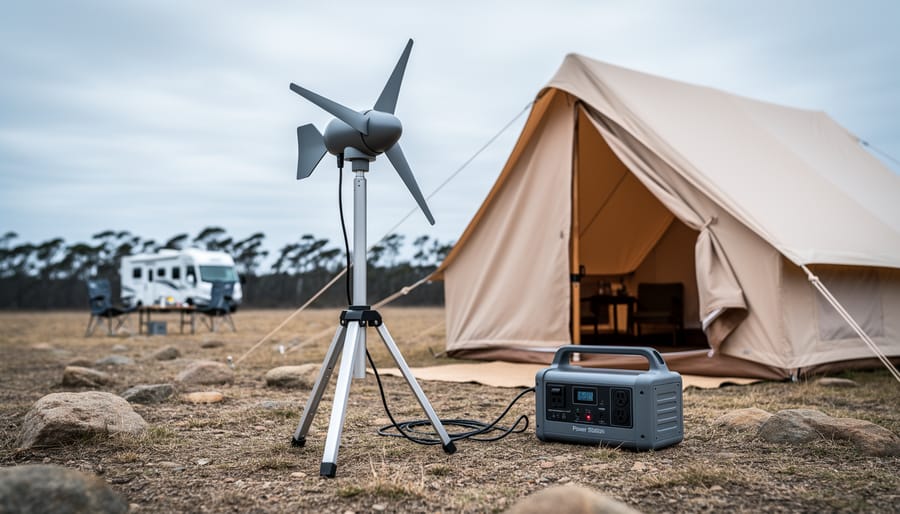
Camping wind turbines fill a specific niche that solar panels and generators can’t address: reliable power generation in windy locations when the sun isn’t shining. While a 100-watt portable turbine won’t rival the convenience of a gas generator or the simplicity of solar, it provides continuous charging potential 24 hours a day in the right conditions. That advantage matters most for extended trips where weather variability could leave solar panels unproductive for days at a time.
The power output reality requires honest expectations. Most portable camping turbines generate between 50 and 400 watts at their rated wind speed, typically around 28 mph. In practice, you’ll often see output closer to 20-30% of rated capacity in average wind conditions. A 200-watt turbine might deliver 40-60 watts consistently in moderate 12-15 mph winds, enough to charge batteries and power small devices but not run high-draw appliances. The value lies in that steady trickle charge accumulating over time rather than peak output.
Noise is a legitimate consideration that varies significantly by design. Horizontal-axis turbines produce a noticeable whooshing sound at higher wind speeds, which can be disruptive in quiet campgrounds but often blends into the ambient wind noise in truly windy locations. Vertical-axis models typically run quieter but generate less power per square foot of swept area.
The strongest case for camping wind turbines is as part of a hybrid system rather than a standalone solution. Pairing a turbine with solar panels creates complementary generation profiles: solar dominates during clear days while wind fills gaps during overcast weather and night hours. For weekend car campers in calm forests, wind power makes little sense. For overlanders exploring Patagonia’s windswept plains or coastal campers in consistent breeze zones, a quality turbine transforms battery management from constant anxiety to reliable autonomy.
Essential Factors to Evaluate Before You Buy
Power Output and Energy Storage Compatibility
Most portable wind turbines generate between 50 and 400 watts at their rated wind speed, but that rated number tells only part of the story. A 400W turbine produces its maximum output only when wind hits its optimal speed, typically 28-30 mph. In lighter breezes around 12-15 mph, that same turbine might deliver just 100-150W. This variability matters tremendously for camping power planning.
Start by calculating your actual needs. A smartphone draws 10-15W during charging, a laptop 50-90W, LED camping lights 5-10W, and a portable fridge 40-60W. Add up what you’ll run simultaneously, then multiply by hours of use to get watt-hours. A 200Wh daily requirement means a 200W turbine needs one solid hour at rated output, or several hours at partial output, to meet your needs.
Voltage compatibility is equally critical. Most camping turbines output 12V or 24V DC, which must match your battery system. Mixing voltages requires a converter and loses efficiency. Look for turbines with built-in charge controllers that prevent overcharging and manage variable input, or verify your existing controller can handle wind input alongside solar panels.
Battery storage bridges the gap between inconsistent generation and steady demand. Without adequate storage capacity, at least 2-3 times your daily consumption, you can’t bank power from windy periods for calm stretches. A 100Ah 12V battery stores 1,200Wh, giving you breathing room when wind dies overnight or between weather fronts.
Weight, Portability, and Setup Requirements
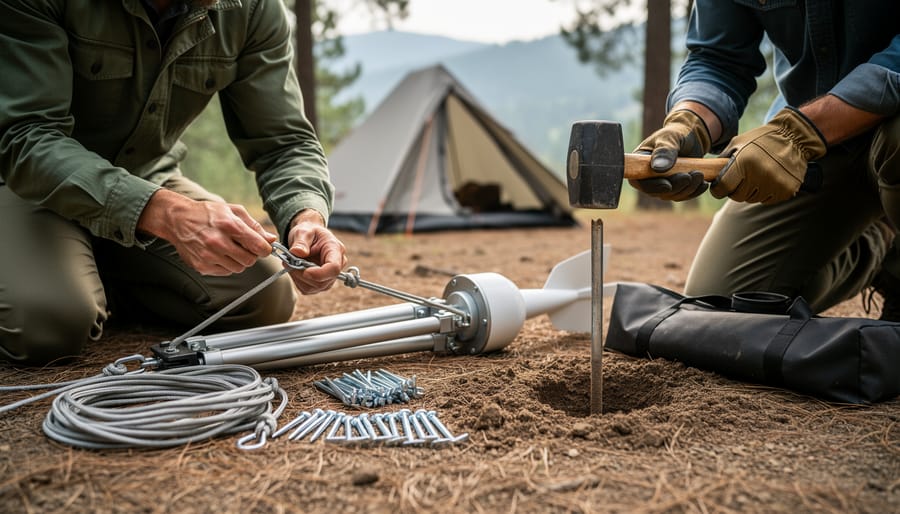
The physical demands of deploying a wind turbine in the backcountry differ dramatically based on your camping style. For car camping and overlanding, units weighing 10-15kg remain manageable since you’re not carrying them far. These heavier systems typically offer better power output and sturdier construction. Backpackers face harder choices: turbines under 3kg exist, but they sacrifice generating capacity and often require compromise on durability.
Packed dimensions matter as much as weight. Look for telescoping poles and detachable blades that compress to 60cm or less. Some designs fold into a carry case the size of a tent stuff sack, while bulkier models might occupy half your vehicle’s storage bin. Check whether the turbine ships with a dedicated carrying case that protects components during rough transit.
Setup time ranges from 15 minutes for simple vertical-axis designs to 45 minutes for horizontal turbines requiring guy-wire tensioning and precise leveling. Most systems need basic tools, a mallet for tent-style stakes, perhaps an adjustable wrench for pole sections. Higher-end models use tool-free quick-release mechanisms, though these add weight.
Anchoring demands serious attention. Guy-wire systems need four to six ground stakes driven 30-40cm deep in firm soil. Rocky or frozen ground renders stake-based anchoring nearly impossible; sandbag or deadweight alternatives then become necessary. Transport durability varies widely. Composite blades withstand jostling better than rigid fiberglass, but protective storage prevents most damage regardless of material.
Wind Speed Requirements and Performance Range
Understanding a turbine’s wind speed performance specifications prevents the frustration of hauling equipment that won’t generate power at your favorite campsite. Three critical speeds define when and how effectively your turbine operates.
Cut-in speed is the minimum wind velocity needed to spin the blades and produce usable electricity. Most portable camping turbines start generating between 6-9 mph (2.7-4 m/s). Below this threshold, you get nothing. Models with lower cut-in speeds offer more operational hours but often sacrifice peak output.
Rated speed represents the wind velocity at which the turbine achieves its advertised wattage, typically 25-31 mph (11-14 m/s) for camping models. This is your sweet spot for charging batteries efficiently. Sustained winds at rated speed are rare in many locations.
Cut-out speed triggers automatic shutdown to prevent mechanical damage, usually around 50-55 mph (22-25 m/s). Quality turbines employ blade furling or electronic braking.
Coastal sites and exposed ridges commonly experience 10-20 mph winds, making them ideal. Forested valleys rarely see adequate speeds. Wind strengthens during afternoon heating and seasonal frontal systems. Download historical wind data for your regular camping areas from weather services. If average speeds hover below 8 mph, solar likely serves you better. The most productive camping locations combine afternoon thermals with overnight gradient winds, maximizing generation when solar panels sleep.
Build Quality and Weather Resistance
Build quality separates camping turbines that last multiple seasons from those that fail on their second trip. The blades carry the highest stress and exposure, making material choice critical. Carbon fiber blades offer the best strength-to-weight ratio and resist UV degradation, but they command premium prices. Fiberglass composite blades provide a solid middle ground with good durability at moderate cost. Budget models typically use ABS plastic, which works adequately for occasional use but becomes brittle after prolonged sun exposure and can crack in freezing conditions.
Corrosion resistance matters most for coastal campers. Look for marine-grade aluminum housings and stainless steel hardware rather than standard steel components that rust rapidly in salt air. Quality turbines specify an IP rating (typically IP54 or higher) indicating protection against dust and water spray.
Temperature operating ranges tell you where a turbine will actually function. Most portable models operate between -20°C and 50°C, but verify this matches your camping destinations. Arctic winter camping or desert summer trips require expanded ranges.
Warranty length signals manufacturer confidence. Reputable brands offer 2-3 year warranties covering defects and premature wear. Anything less than one year suggests questionable construction quality.
Types of Portable Wind Turbines for Different Camping Styles
Horizontal-Axis Turbines
Horizontal-axis wind turbines (HAWTs) use the classic three-blade propeller design you’ll recognize from large-scale wind farms, scaled down for recreational use. These models orient themselves parallel to the wind direction and typically generate 100-400 watts, making them the most powerful portable option for camping applications.
HAWTs deliver superior efficiency when positioned in steady, directional wind because their streamlined design captures maximum energy from consistent airflow. This makes them ideal for open locations like coastal campsites, prairie overlook sites, or ridgeline base camps where wind patterns are predictable. The rotating blades drive a generator housed in the nacelle, converting kinetic energy into electrical current that charges your battery bank, a more robust system than what you’d need for basic electric interconnection in stationary installations.
The primary consideration with HAWTs is height: they require mounting 10-20 feet above ground on a telescoping pole or tripod to access cleaner wind above terrain turbulence. This makes them best suited for car camping or semi-permanent base camps where you can transport and erect the support structure. Setup takes 20-45 minutes and requires guy-wire anchoring for stability, but the power output justifies the effort if you’re staying multiple days in windy conditions.
Vertical-Axis Turbines
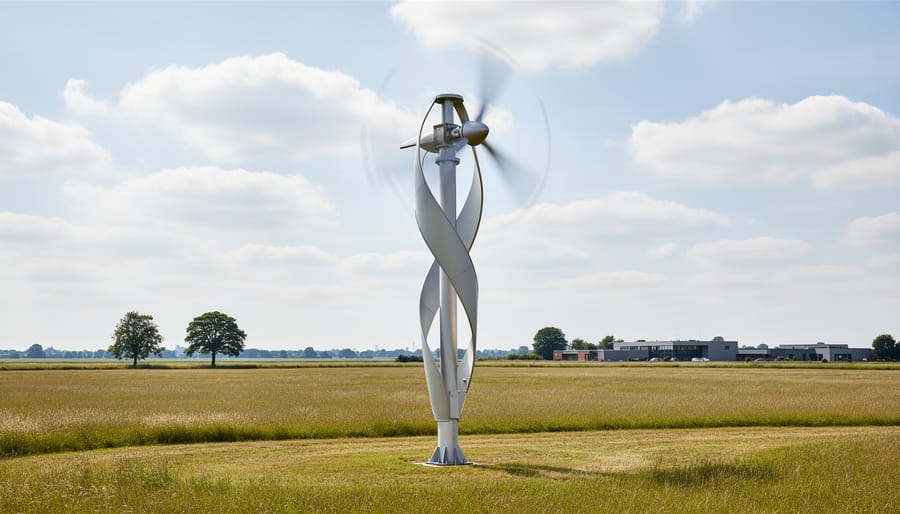
Vertical-axis turbines spin around a central shaft perpendicular to the ground, capturing wind from any direction without needing to reorient. This omnidirectional capability makes them ideal for camping locations with variable or swirling wind patterns, where traditional horizontal turbines would constantly need repositioning.
These designs typically operate more quietly than propeller-style turbines because blade tip speeds are lower and the rotation pattern creates less aerodynamic noise. If you’re camping in areas with quiet hours or near other campers, this matters significantly.
Vertical-axis models generally start generating power at lower wind speeds, often around 6-8 mph compared to 9-12 mph for horizontal designs. Their compact footprint and lower height requirements make them practical for tight camping spots where clearance is limited or where you can’t guy out tall support wires.
The efficiency trade-off is real, though. These turbines typically convert 25-35% less wind energy into electricity compared to horizontal-axis models in optimal conditions. They’re best suited for weekend campers with modest power needs, confined spaces like beach camping between dunes, or situations where setup simplicity and quiet operation outweigh maximum power generation. For extended off-grid trips requiring substantial charging capacity, horizontal turbines usually deliver better results despite their setup complexity.
Micro Turbines for Ultralight Camping
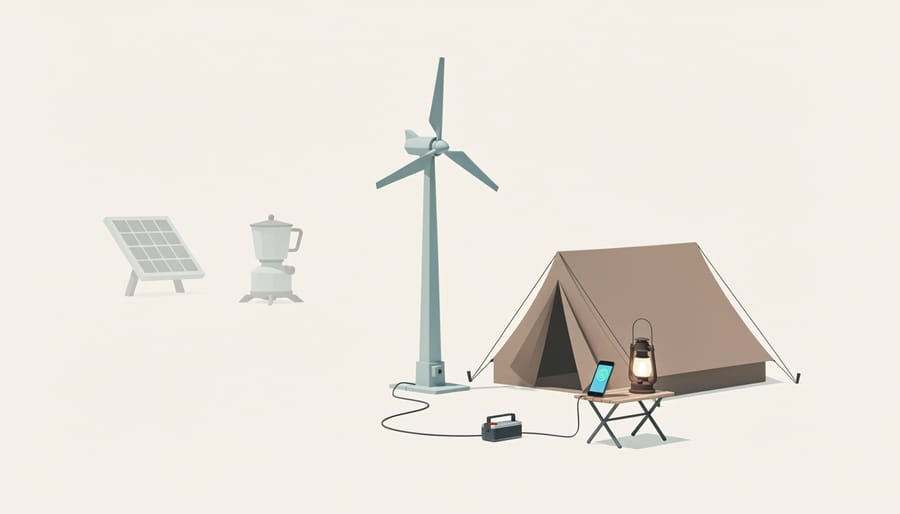
Micro turbines designed for ultralight camping typically produce 30-80W in favorable wind conditions and weigh between 800g and 1.8kg, a significant pack burden that demands careful justification. These compact systems fold down to roughly the size of a trekking pole, making them transportable for multiday hiking trips, but their real-world contribution is more limited than marketing suggests.
In steady 15-20 mph winds, expect these units to generate enough power over 6-8 hours to fully recharge a 10,000mAh power bank or directly charge two phones and a headlamp. That’s useful for extended trips where solar panels can’t gather enough light, particularly in forested valleys or during overcast stretches in late fall and early spring. However, wind must be consistent, gusty conditions common in mountain passes produce erratic charging that battery management systems struggle to regulate efficiently.
The critical calculation for backpackers: a 1.5kg micro turbine occupies the same pack weight as three 20,000mAh batteries, which provide known, reliable capacity regardless of weather. Wind turbines make sense only when you’re committed to trips exceeding four or five days in exposed, reliably windy terrain like alpine ridges or coastal routes. For most weekend warriors, the weight penalty outweighs the benefit.
Combine micro turbines with a small solar panel rather than choosing one or the other, wind captures energy during stormy weather and overnight when solar sits idle, creating redundancy that’s worth the extra weight on serious wilderness expeditions lasting a week or longer.
What to Look for in 2026: Current Features and Innovations
Modern portable wind turbines have evolved significantly, but not every new feature justifies the price premium. Focus on innovations that solve real camping challenges rather than technological bells and whistles that add complexity without meaningful benefit.
Smart charge controllers with MPPT (Maximum Power Point Tracking) technology represent one of the most valuable advances for camping applications. Unlike basic PWM controllers, MPPT systems extract 20-30% more power from variable wind conditions by constantly adjusting the electrical load to match optimal turbine performance. This matters enormously when you’re camping in locations with inconsistent wind speeds that fluctuate throughout the day.
Integrated battery management systems now protect your lithium batteries from overcharging and deep discharge cycles that shorten lifespan. Look for turbines with built-in three-stage charging profiles that automatically adjust from bulk charging to absorption to float maintenance. This prevents the battery damage that occurs when simpler charge controllers keep pushing current into already-full batteries.
When evaluating 2026 models, prioritize features that enhance reliability and usability:
- MPPT charge controllers that optimize power extraction in variable wind
- Integrated battery management with temperature compensation for lithium systems
- Tool-free collapsible blade designs that reduce packed size and setup time
- Bluetooth monitoring that tracks real-time output and battery status
- Corrosion-resistant carbon fiber blades for coastal camping environments
- Automatic furling or electronic braking to prevent overspin damage in gusts
Be skeptical of features that sound impressive but add little practical value. App connectivity that only displays basic voltage and current provides marginal benefit over a simple multimeter. Similarly, turbines advertising “aerospace-grade materials” without specifying actual corrosion resistance or impact durability often charge premium prices for marketing language rather than proven performance advantages.
Collapsible blade designs have improved dramatically, with quick-release systems that let you break down the turbine in under two minutes without tools. This matters when weather changes rapidly or you need to secure equipment before leaving camp. The best designs maintain structural rigidity when deployed while folding to less than half the assembled diameter.
Common Mistakes Campers Make When Choosing Wind Power
The biggest error campers make is trusting the rated wattage printed on the box without researching actual wind speeds at their favorite sites. A turbine advertised as 400W only reaches that output in ideal conditions, usually 28 mph sustained winds, while most camping locations average 8-15 mph, delivering a fraction of the promised power. Before investing, check historical wind data for your typical destinations or you’ll end up with an expensive tent ornament.
Many campers also underestimate the physical footprint required for safe operation. Portable turbines need guy-wire anchoring in a roughly 10-15 foot radius, and blades must clear trees, tents, and vehicles by several feet. Trying to squeeze a turbine into a crowded campsite creates safety hazards and often violates campground regulations about protrusions into shared spaces.
Noise levels catch people off guard, particularly with horizontal-axis designs that produce a rhythmic whooshing in moderate winds. What seems acceptable during daytime setup becomes intrusive at night in quiet campgrounds where sound carries. If you value good relations with neighboring campers or plan to use designated quiet zones, factor in decibel ratings and consider vertical-axis models that operate more quietly.
Undersizing the system relative to your battery bank causes another frequent problem. A 100W turbine paired with a 200Ah battery will take days of consistent wind to provide a meaningful charge, leaving you power-starved during calm periods. Your turbine should generate enough daily watt-hours to offset consumption plus account for inefficiencies in MPPT battery charging and storage losses.
Finally, neglecting compatibility with existing power systems creates expensive headaches. Verify your turbine’s voltage output matches your battery bank and that its charge controller can integrate with solar panels if you’re building a hybrid setup. Mismatched components require additional converters and adapters that add weight, cost, and potential failure points in the field.
Making the Right Choice for Your Camping Power Needs
Your camping power needs depend on three core variables: how you camp, where you camp, and what you’re powering. Let’s build a decision framework that cuts through the marketing noise.
Start with your camping style. Weekend car campers who drive into established sites can justify heavier, more capable 200-400W turbines paired with substantial battery banks, you’re not carrying gear on your back, and multi-day wind generation offsets the initial investment. Overlanders and van-lifers benefit most from hybrid systems where a turbine supplements roof-mounted solar, covering overnight loads and cloudy stretches. Backpackers should be skeptical: a micro turbine under 100W only makes sense if you’re camping above treeline for extended periods where wind is reliable and you need more than solar alone can provide for communication devices.
Next, evaluate your typical destinations honestly. Coastal campgrounds, prairie sites, and mountain ridges above 2,000 meters offer the consistent wind that makes turbines worthwhile. Forested valleys and protected lakeshores don’t, you’ll struggle to reach cut-in speeds, and your investment sits idle. Check historical wind data for your regular spots before buying.
Calculate your actual power consumption. List every device you’ll charge and its watt-hour requirements. Add 30% for inefficiencies. If you’re running a 12V fridge, LED lighting, and laptop charging, you’re looking at 50-80 amp-hours daily, a realistic target for a 200W turbine in good wind paired with 200Ah of battery storage.
Budget for the complete system, not just the turbine. You’ll need a charge controller, adequate battery capacity, and potentially solar panels for reliability. Effective sustainable power solutions rarely rely on a single source. A $600 turbine becomes a $1,500 investment once you factor in the supporting infrastructure, but that hybrid approach delivers consistent power across variable conditions.
Frequently Asked Questions
Can I charge my battery directly while driving with the turbine mounted on my vehicle?
Most portable wind turbines aren’t designed for vehicle mounting during travel due to the unpredictable airflow and vibration stresses that can damage blades and bearings. The laminar airflow required for efficient generation doesn’t occur around moving vehicles, making this approach ineffective and potentially dangerous.
How do portable turbines handle gusty versus steady wind conditions?
Turbines generate more consistent power in steady winds where they maintain optimal RPM ranges. Gusty conditions cause fluctuating output and can trigger safety shutdowns to prevent damage, though quality charge controllers help smooth the delivered power to your battery.
Do I need permits to use a wind turbine on public lands?
Most campgrounds allow personal wind turbines under three meters in height, but check specific regulations for national parks, wilderness areas, and private campgrounds before setup. Some locations restrict structures that could impact wildlife or viewsheds.
What’s the realistic lifespan of a camping wind turbine?
Quality portable turbines typically last five to ten years with proper maintenance and storage, though bearings and charge controllers may need replacement around the five-year mark. Turbines used exclusively in harsh coastal environments or transported frequently tend toward the lower end of that range.
How can I prevent theft at campsites?
Use a cable lock through the base or tower sections, engrave identification marks on components, and take down the turbine when leaving camp for extended periods. Choosing campsites with better visibility from your tent or RV also deters opportunistic theft.
What field maintenance do these systems require?
Check guy-wire tension and anchors daily, especially after high winds. Inspect blade surfaces for nicks or damage that could cause imbalance, clean the charge controller connections, and apply dielectric grease to electrical contacts in humid environments. Most other maintenance happens between trips.
Beyond these practical concerns, remember that wind turbines work best as one component of a hybrid renewable system for camping. Pairing wind generation with solar panels and adequate battery storage gives you reliable power across different weather conditions and times of day. A 200W turbine might generate nothing during calm mornings but contribute substantially during afternoon breezes, while your solar panels work hardest at midday. This complementary generation pattern reduces your reliance on any single power source and extends your off-grid capability.
Keep realistic expectations about noise as well. Even quieter vertical-axis models produce audible swooshing in moderate winds, which some campers find soothing but others consider disruptive. Test your turbine at home before assuming it’ll blend into the background at a peaceful wilderness campsite, and position it downwind from sleeping areas when possible.
Portable wind turbines represent a specialized addition to your camping power toolkit rather than a standalone solution. They shine in environments with consistent wind, coastal sites, prairie campgrounds, mountain ridges, where they complement solar panels by generating power during overcast days and throughout the night. Success hinges on realistic expectations: a 200W turbine won’t power an RV air conditioner, but it will steadily charge batteries that run your essentials.
The campers who benefit most approach wind power as part of an integrated renewable system. They’ve assessed their typical destinations for wind resources, calculated their actual power needs, and invested in quality battery storage that balances solar and wind inputs. They understand that some camping trips will yield abundant wind energy while others require backup options.
Before committing to wind power, evaluate your camping patterns honestly. Weekend warriors in sheltered forest campgrounds gain little advantage, while extended off-grid travelers in open terrain often find turbines invaluable for energy independence.
If you’re designing a custom off-grid power system for serious camping or overlanding, professional guidance ensures your investment matches your actual needs and environments.